Be yourself; Everyone else is already taken.
— Oscar Wilde.
This is the first post on my new blog. I’m just getting this new blog going, so stay tuned for more. Subscribe below to get notified when I post new updates.
I shall take and embrace each day I live and hold it close, taking things one day at a time.
Be yourself; Everyone else is already taken.
— Oscar Wilde.
This is the first post on my new blog. I’m just getting this new blog going, so stay tuned for more. Subscribe below to get notified when I post new updates.
It’s been a while– it’s been a stressful, long while. Many things have happened since I started my journey in English 212 at the beginning of January. The first two months were what I expected out of an English course. There was lots of reading, pondering, processing, and of course writing involved, but that’s to be expected in a English course. There weren’t that many big projects which was actually pretty nice because it allowed me to show my thoughts and personality within those papers while still maintaining a formal tone for each of the papers that was asked for us students to write about. I really enjoyed looking at the different world of maps, lines, and numbers as something other than just words; I never thought I’d be able to write rhetorical type papers either until now.
Well since January, I feel that I have grown as a writer and how I write based on the topics I choose and or am given. My mindset has expanded to look at things in other ways and other points of view. I am forever changed, now a map is no longer a navigational tool, it’s a story of an area; a line may be the key to understanding where one comes from or the mindset of an era; numbers are the key to how we understand some of the most confusing parts of ones life. Thanks to all the different sources and topics, as well as the open-mind that my teacher had, I was able to explore maps, lines, and numbers in ways that most interest me and could help others understand the ideas that come along within writing.
When I look at maps or timelines now, I automatically want to understand more. Going past what one can just physically see, but go deeper into the development of the map/timeline. Is there a greater influence to how the visual was created? What was the reason that the creator choose that visual? What’s the deeper meaning that’s not being displayed? These questions show up when I see maps, charts, lines, and even data. I now know that I can find a way to make sense of these questions and thoughts and relate them to different ideas of writers, even if they sound strange and unusual at first.
Visual text is a hard concept to grasp at first; it’s a hard concept because in grade school they don’t really teach students to look further into the visuals they are given, versus giving them a text-based book (filled with only words) –telling them to read it– and write about what they read. Honestly, I struggled with the first paper on maps due to the fact that writing about a visual and proving an idea that maps are more than just maps using “factual” evidence was mind-boggling. However, as I began writing and re-reading and going over the sources given in the English class it was more understandable and easier to write about as my semester went on. With each paper writing rhetorically came more naturally.
Overall, I can say I enjoyed this English course. It encouraged me to move out of my “high school” comfort zone in writing and pushed me to explore new areas of writing. Since this semester is coming to a close, I want to say that with all the craziness that went on mid-semester I genuinely believe that I became a better writer due to my English 212 course. If I had to choose the best assignment that I enjoyed and learned the most– our first big project (even though the blog post on our psycho-geographical walk was really fun). The first project over maps was the best because it was the gateway to best understanding the new thought processes I must go through to be the best writer I can be. With that being said, I think I wrote up all the loose ends to my Winter 2020 semester and a close to my freshman year of college.
Why hello there! It’s been a bit since the last post, but here I am, and this week is based upon the idea(s) of organization, specifically taxonomies and folksonomies. These words may sound odd, but I shall explain dear reader.
Taxonomies are a more traditional form of organization, involving a more ridged and structured form, such as making a list and putting certain items in a specific category. This give the makers of a taxonomy authority over the order and structure over the content of what’s being organized.
Folksonomies are for free flowing and open ways of organizing. There is not one specific way to group or label something and there is not right and wrong way of organizing when it comes to a folksonomy. Take an Instagram post for example, and the user used a hashtag to put it in a specific category, but the picture can have multiple other hashtags that can go along with it; this is technically a folksonomy.
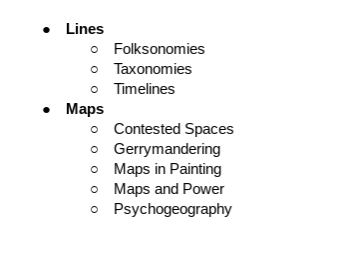
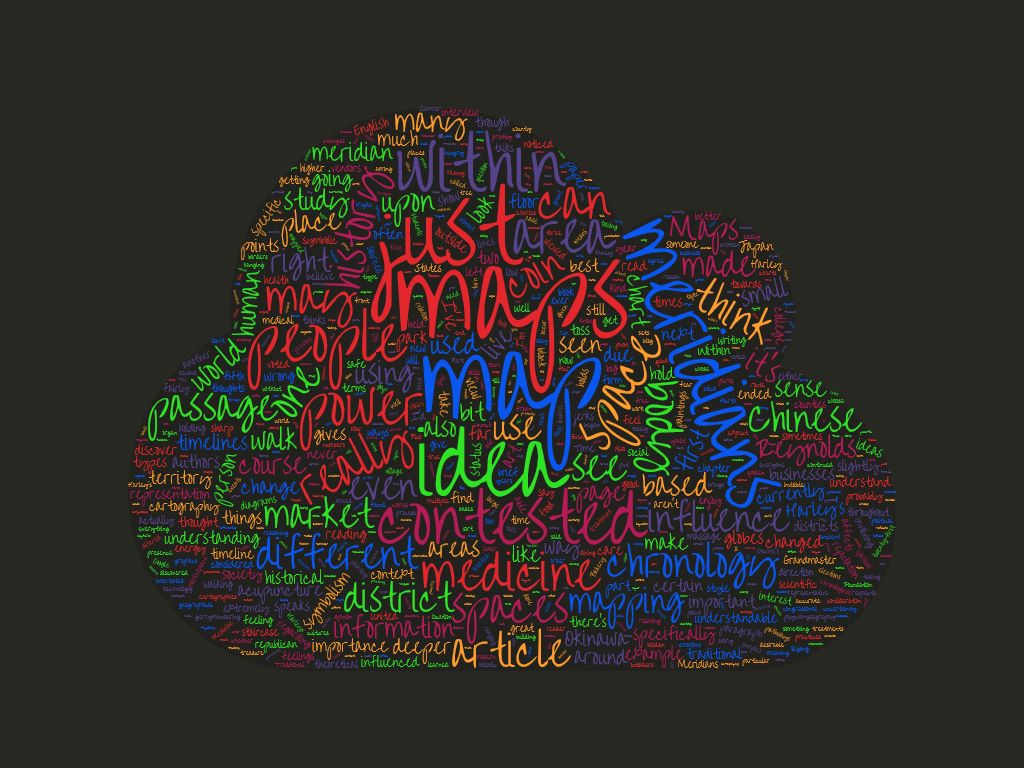
For my taxonomy I used the topics and things I learned and worked on throughout my English course. I started off the taxonomy by ordering by the most recent main idea that the class is over- Lines. Then I listed the concepts that go along with the main idea in alphabetical order, so folksonomy, taxonomy, timelines. Ironically, it’s also in order with relevance to what I learned most recently within our lines section. Then I did the same thing just with the main idea of maps. I found that this was most helpful in organizing what has gone on within my English class. The folksonomy I created was a word-cloud using the writings from my discussion posts, blogs, and paper. This was to find out what words were most prevalent within my writing during the different assignments I have done within English 212. I was curious to see in comparison, would the main ideas and concepts within my assignments, blogs, and paper show up within the word-cloud.
The difference between the two ways of organizing is striking. One hand the difference between the two types of organization being so different makes sense. On the other hand, when you look at the craziness and almost aloofness of the folksonomy it may make one wonder how in the world it that it’s considered “organized”. What I took from the big difference between the two forms of organizing are on different spectrums of organization. For example folksonomy is much like when a person has an extremely messy room but knows where everything is, where as taxonomy is like the super neat and set room that everything is labeled and has its spot.
My opinion on these two types of organization are truly hard to exactly pinpoint. I understand that the expressive aloofness of folksonomy can be helpful in expressing a specific point of organization, such as repetitiveness. Where as taxonomy is really good for quick to the point labels and structure. Folksonomy also comes in handy when you can’t put something in one specific category, like is mainly done with taxonomies. I really do enjoy how open a folksonomy is with its organization. It allows things that are similar or relevant to be included in a space where as in a taxonomy is so structure based somethings are overlooked or not included that could be important. A folksonomy could actually be very helpful when doing some research in the sense that it can give you similar or recommended intel where the taxonomy would be good for a straightforward and fact based area of organization.
I think that the two ways of organization all have their part to play in our world to help us comprehend and take in information. Some do better with more structure, while others are well off with something more free flowing. I believe that organization has to work best for the person or what the person is doing that they need to be organized. Either way, being somewhat organized- even if you could define it as controlled chaos- is better than being totally unorganized and discombobulated. Preferably I think I’d go with the folksonomy type of organization, because it seems when I am extremely structured in my organizing it some how goes south for me and I am in a worse space than where I started.
That’s all for this weeks blog post! Till next time, I hope this made you ponder a bit on what type of organization best fits you and your life.
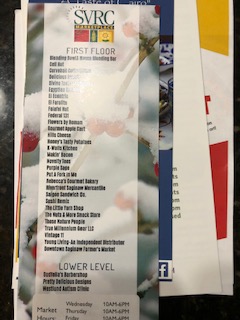
For this weeks blog, the topic is psycho-geography. Yes, psycho-geography… and you may be very confused by the word and probably have no clue to what it means, just like I did when I first read about it within my English Class. Well to put it in “fancy shamancy” terms it is, “the study of the precise laws and specific effects of the geographical environment, consciously organized or not, on the emotions and behavior of individuals.” but to put it simply– it’s the thoughts, feelings, and emotions a place has on a person while they are in a place. For example when someone is in Meijer (local grocery store) they may feel irritated or upset when they see that there are many people, as well as they can’t find what they need. Many may take a psycho-geographical walk to change up the routine on their mundane commute to wherever they may be going. So, they might take a different route, or they decide that they are going to flip a coin– heads, take a right at the next block, tails, take a left at the next block, and so on till they get to their destination.
You may be thinking, “Ok, so it’s a fancy way of how walking around a place makes you feel or act. What’s that have to do with this post, or navigating a market?” Well my dear reader, everything. I did a psychogeographical walk… in the SVRC Marketplace. The market is made of a bunch of small local businesses that all operate within the same building, it has multiple floors and has a actual farmers market that runs in the Summer, but currently in Michigan it’s winter.. so I just stayed in the building– specifically the first floor (second floor is mainly for businesses or organizational meetings). Bringing up the coin toss for direction from the previous example that’s how I perused through the first floor of the market.

Here’s how the walk began. As you enter the market through the two sets of glass double doors there is a small area that has some tables and such, as well as some posters hanging on the wall, and a small three or four step staircase that starts the first floor. There you look to the right and see a shop that sells merchandise right next to another business called Sushi Remix. Then right in front of you there’s a piano and a staircase that leads to the second floor. Behind that staircase slightly to the left, you can faintly look at some of the other small businesses in the market.
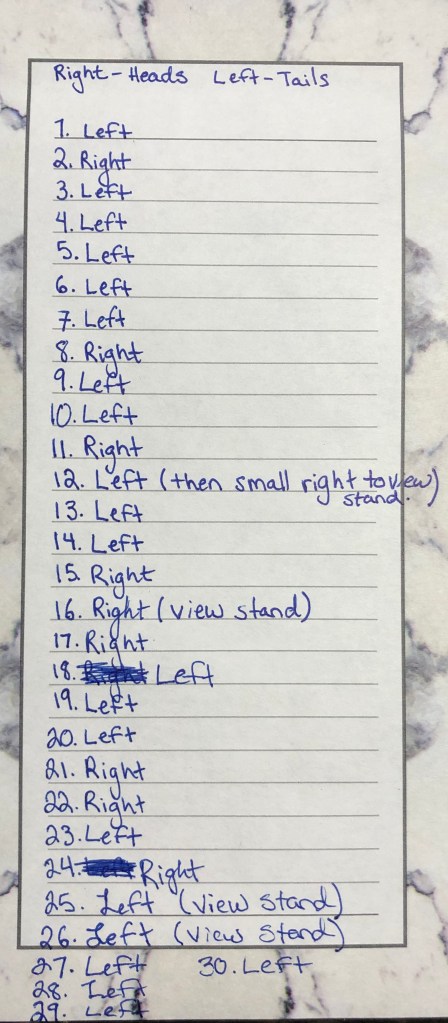
This spot right in front of the stairs is where I made the first coin toss and so began my walk. Moving past the stairs, the coin had landed on tails– the course was to go left. As I navigated the long hall that had several small food businesses lined up next to each other, ranging from Pho– a Vietnamese soup– to a Gourmet Bakery. The coin toss continued for twenty-nine more tosses till I ended my psycho-geographic walk because there was no more market to see. The coin toss– it was irritating– me being me I just wanted to look at everything, and the coin made me go around the same small businesses almost three times.
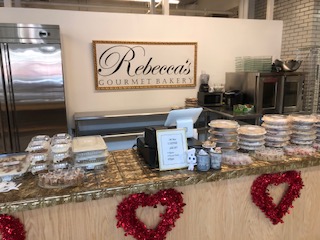
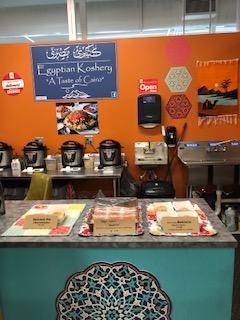
As, I went around the market I was treated so nicely. The workers/ owners were very kind and very informative about their business. All the different types of vendors and things to look at and see at the market was very exciting and entertaining, it made going around the same block a couple times worth it. I’m not going to lie to you all– do not go there hungry and expect free samples. While on my mapped route you can see I took a turn towards some vendors without using the coin; why? They had samples, I was hungry; I never turn down free food. I ended up trying some great desserts that made not just my taste buds, but me, myself , and I as a whole very happy. Rebecca’s Gourmet Bakery– sample heaven, super tasty.
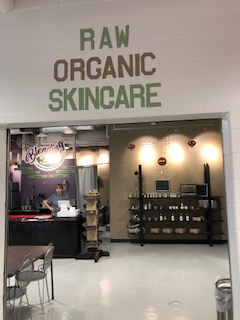
On this excursion of the marketplace and dealing with tossing a coin every other minute, I really enjoyed walking and looking at all the things the market offers. The variety of vendors is very refreshing and they all have their own charms, they range from food, to clothes and accessories, to collectibles, to even skin care. I even ended up running into the owner of the marketplace, she happen to see me walk around constantly tossing a coin– the psychogeographic walk idea ended up really peaking her interest. I enjoy the idea of taking new routes and trying new ways of getting to a place, but I’d like to do it on my own terms just to be able to focus on the surroundings more than how I am walking throughout the market.
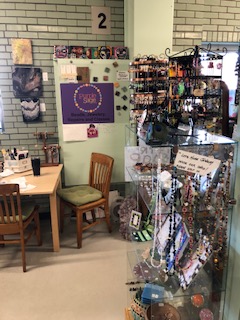
To end my psychogeographic navigation through the market I will say this, It was an experience. I was glad to not be there alone in the market, I had my boyfriend and mother there with me, If I had been alone I probably would have been a bit overwhelmed by everything there and not appreciated what was there. I think that it would be good for someone who is tired of taking the same monotonous route to switch it up and say “I’m going to turn right at this next light and see where it takes me.” is good every once in a while so the brain can stay sharp and focused, plus a person could gain a new preference in the way they go about things. They may also get time to reflect on more things when they aren’t as worried about the way they get to a place. I may start implementing some more psychogeographic walks while I’m at Saginaw Valley, just to spice up getting to class.
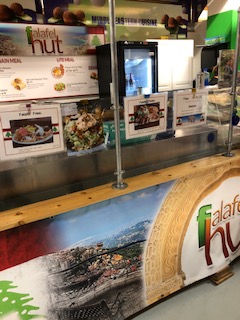
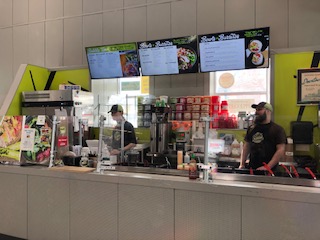
Here are some more pictures of the SVRC Marketplace that I took while on my walk.


Hello and welcome to my blog–One Day At A Time– my name is Shayla Siniff. A quick bit of information for you the reader! I’m a freshman in college and currently I’m taking an English course. The course requires some writing about our thoughts and opinions, hence the blog. Within the course I aim to learn how to best convey my inquiries about some subjects or objects of the crazy world in which I am a living being. This may involve talking about the things I find enjoyment in such as, working out, singing, dancing, volleyball, art, chiropractics, and nutrition. The class should help influence my writing to be more understandable and thorough within other classes, as a college student. Hopefully blogging will give me a way to let myself be slightly creative, all the while still improving my writing skills. Allowing my thoughts to be more fluid and easier to comprehend to those reading would be extremely helpful!

On that note, currently in the English course (that was spoken of in the previous paragraph) we are reading and discussing about maps- specifically, how maps can tell a story. Maps are narratives and can tell a story or some history just through its lines, symbols, and colors printed. Many people when they think of maps don’t dive in any further, and have no consideration for the ideas that a map may be something other than a way to get from one place to another or a source of information. Nor do people think of the thought process on how much thought and planning may go into the creation of a map. For instance–think of that treasure hunting map that you used for a game at a birthday party– many don’t think about the effort and consideration the creator of the map had to go through to make it understandable for you to find the “hidden treasure”, even though it was just within the backyard of the home.
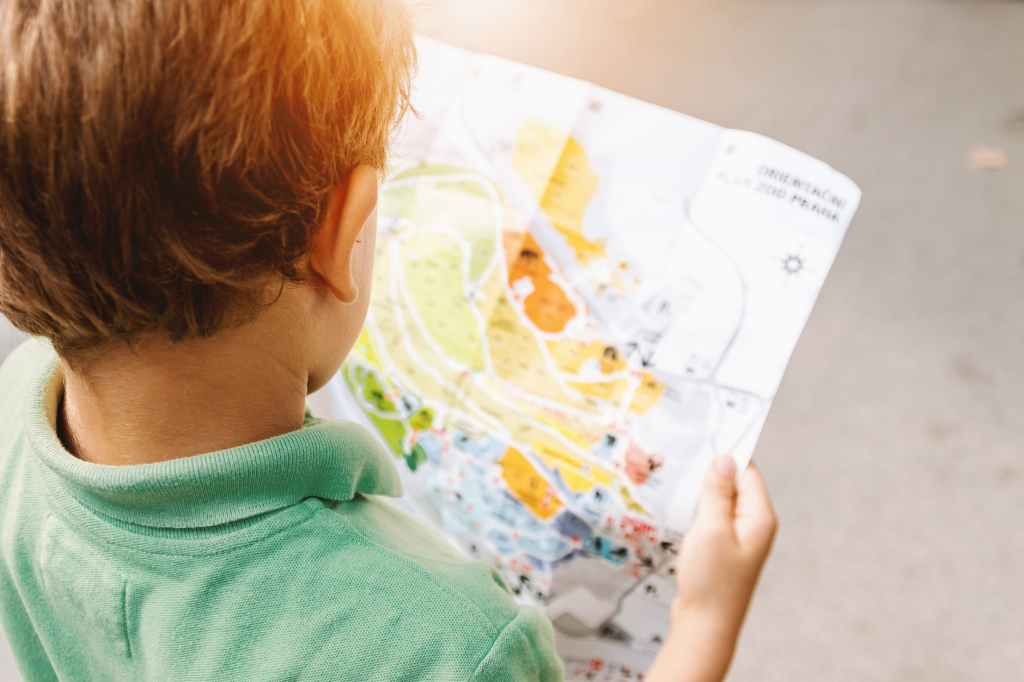
Here is a quick thought just to stick in your brain- what would you do if the map you have or were given is wrong. Completely and utterly incorrect. You’d be out of luck, right? You would probably be pretty upset. How could someone make a map wrong– easily, very easily. Nobody ever thinks of a map being wrong, they just expect it to be accurate and all the same.
A map, it’s made up of ink and paper, but we never give the creators of maps the credit they’re due. They have to give an accurate depiction of an area, make it understandable, and fairly presentable so someone wouldn’t mind glancing upon its numbers, shapes, and lines. We rely on these map makers to hold morality in what they are creating, so that we may be able to use it for information. Have you ever noticed how many different type of maps there are? How about the different changes of maps from year to year of an area. A map of the United States now is not the same as it was in 1890 or even 1920. If one lined up a bunch of maps of the Eastern hemisphere over the decades, you could view history and the shifts and changes of the territories. Looking at a map you could infer the terrain based on the style in graphics of the map. This is often not considered when a person hears “map”.
Due to my English course, I’ve come to realize that things sometimes have a deeper meaning and it’s all within context and how it’s used. I may be reaching a bit, but I believe that the idea of this course is going to push me to look deeper into how things are taken. The composition of text, wording, and punctuation can influence all how one can best understand what they’ve read. Currently, there’s a feeling of uncertainty and eagerness in my blood. I wonder what awaits the next few pages in my book of life, maybe I’ll be in need of a map to stay the right course.
The alarm goes off at seven. It doesn’t matter I was tossing and turning in anticipation all night. I didn’t have the greatest first semester at Saginaw Valley, but this semester will be different! I wanted to at least try to have a positive attitude about going back to college and look forward to the day ahead.
The school day started with my first lecture– chemistry. Now, don’t get me wrong I liked chemistry in high school. I even took the extra class I wasn’t required because I enjoyed it, but it had it’s moments to be really boring. The truth is…. I really liked it! I think I won’t mind going to chemistry at 8:30 in the morning. The professor seems really nice and seems to care about how his students do in his class.
After chemistry is what I like to call– Dead period. Where I literally have nothing to do till 2:30 when my history class begins (at least on Tuesdays..) and ends at 3:50 p.m; Today, I used this time to figure out what the heck was going on with my classes! All my classes that were mainly based on the computer–NOT WORKING! I did get it figured out though thank the heavens.
Then we end the school day with history. I wasn’t really sure of what to expect with this class and professor. I really had no idea what I was heading into, I just was trying to cross off a general education credit. I’m still a bit on the fence about how I feel about the class– but we shall see! I don’t deny that I was ready to come home once the class ended. I have my lab for chemistry tomorrow and then I get to do today all over again, back to the daily grind.

This is an example post, originally published as part of Blogging University. Enroll in one of our ten programs, and start your blog right.
You’re going to publish a post today. Don’t worry about how your blog looks. Don’t worry if you haven’t given it a name yet, or you’re feeling overwhelmed. Just click the “New Post” button, and tell us why you’re here.
Why do this?
The post can be short or long, a personal intro to your life or a bloggy mission statement, a manifesto for the future or a simple outline of your the types of things you hope to publish.
To help you get started, here are a few questions:
You’re not locked into any of this; one of the wonderful things about blogs is how they constantly evolve as we learn, grow, and interact with one another — but it’s good to know where and why you started, and articulating your goals may just give you a few other post ideas.
Can’t think how to get started? Just write the first thing that pops into your head. Anne Lamott, author of a book on writing we love, says that you need to give yourself permission to write a “crappy first draft”. Anne makes a great point — just start writing, and worry about editing it later.
When you’re ready to publish, give your post three to five tags that describe your blog’s focus — writing, photography, fiction, parenting, food, cars, movies, sports, whatever. These tags will help others who care about your topics find you in the Reader. Make sure one of the tags is “zerotohero,” so other new bloggers can find you, too.

 One Day At A Time